
November 27, 2026
Can Aquatic Therapy Help Low Back Pain?
Warm-water aquatic therapy carries part of your weight as you move and strengthen a sore low back. What studies show, who starts in the pool, and referrals.
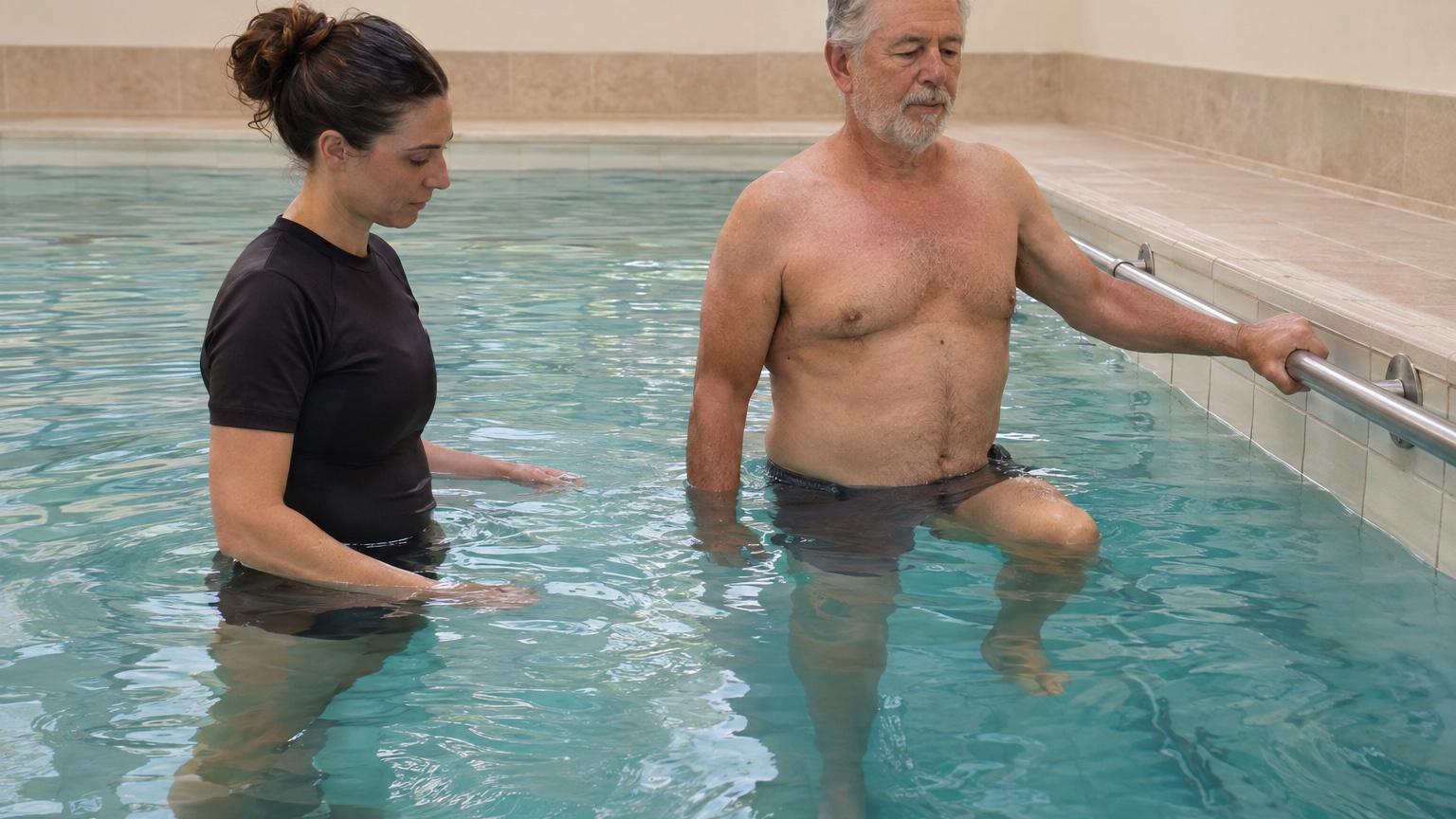
Yes, exercising in warm water can give you a gentler way to move and build strength when you have low back pain, because the water carries part of your weight. Studies of adults with chronic low back pain have found that supervised pool exercise can ease pain and help people do more day to day.
Below, we'll look at how warm water helps a sore low back, what the research shows, who is a good fit for aquatic therapy, what a program involves, and how to get started with aquatic therapy at our Wallingford office.
How warm water helps a sore low back
Stepping into our warm-water therapy pool in Wallingford changes how your lower back handles movement. In aquatic therapy, buoyancy reduces the effects of gravity so you can move, bear weight, and exercise earlier and with less pain than on land. Meanwhile, warm water promotes muscle relaxation, increases peripheral circulation, and helps decrease pain sensitivity. It's the same comforting warmth you get from a heating pad or a heated car seat, except in the pool it surrounds your lower back while you move.
Moving through water adds a second benefit: natural resistance in every direction. That resistance turns gentle motion into strength training without heavy weights or jarring impact. Because water supports part of your body weight and reduces stress on your joints (opens in a new tab), movements that feel sharp on a gym floor can feel more manageable in the pool. For a closer look at depth, water temperature, and buoyancy, read our earlier article on how water unloads painful joints.
What research shows about aquatic therapy for back pain
Making movement easier matters for a simple reason: with recent low back pain, continued activity improves pain intensity and function more than rest (opens in a new tab). When pain lasts longer than 12 weeks, the American College of Physicians' guideline recommends exercise among the initial non-drug treatments (opens in a new tab).
Studies focused on pool exercise show encouraging gains of their own. In one randomized trial of 113 adults with chronic low back pain, three months of therapeutic aquatic exercise brought greater improvements in daily function and pain (opens in a new tab) than electrical stimulation and infrared heat alone. Those differences were still present at the 12-month follow-up, and the pool group also scored higher on sleep quality and quality of life.
A 2026 analysis of 26 randomized trials found a similar pattern: pool exercise reduced pain and improved daily function (opens in a new tab) compared with no active treatment, though individual studies varied in size and design. Among single approaches, aquatic exercise tended to rank above land exercise by a small margin, while programs that combined water-based care with general care or exercise tended to do best. That fits the way we work at our Wallingford clinic, where our physical therapists can build a pool program, a land-based program, or a combination of both. The right starting place is whichever setting lets you move comfortably and stick with your plan.
Who is a good fit for aquatic therapy
For patients whose pain or weight-bearing limits make land-based exercise difficult to start, our Wallingford pool is a practical starting place. When standing, walking, or bending on solid ground flares up your lower back, buoyancy can let you begin moving sooner. Back pain, however, is only one part of what we treat in the pool. Our therapists also use aquatic therapy for arthritis and joint pain, non-surgical orthopedic conditions, pre- and post-surgical recovery, and sports, auto accident, or work injuries.
Aquatic therapy is one of the most effective rehabilitation methods we offer, though it isn't appropriate for every patient or condition. If you're considering it, consult with your physician or talk to our physical therapy team. We'll evaluate whether the pool, a land-based program, or a combination is the right path for your recovery.
Starting in the water doesn't lock you into the pool for your entire recovery, either. To see how our therapists weigh the two settings, read our comparison of aquatic and land-based physical therapy. If your low back pain also shoots down a leg, our post on physical therapy for sciatica explains how nerve symptoms guide that evaluation.
What an aquatic therapy program for back pain involves
Unlike lap swimming or a water-aerobics class, aquatic therapy is structured rehabilitation guided by a licensed physical therapist. At Omni, we design each program for the individual to improve function, flexibility, strength, balance, and coordination, as well as aerobic capacity, gait, body mechanics, and postural stabilization. For a sore back, physical therapy helps strengthen the muscles that support your spine (opens in a new tab), which can improve mobility, posture, and positioning while easing pain.
Working in our therapy pool also stimulates body awareness, balance, and trunk stability. Over time, combining aerobic exercise with specific exercises keeps the muscles in your back and abdomen strong and flexible (opens in a new tab). Your therapist can coach you on how to stand, sit, and lift safely, too.
If you're unsure about getting into a pool, you don't need to know how to swim. Exercises are performed at depths where you can stand, under a physical therapist's direct guidance, and flotation support is used where needed. For what to pack, what to wear, and how a typical session runs, check our guide to what to wear to aquatic therapy.
How to get started with aquatic therapy at our Wallingford office
Like physical therapy, aquatic therapy always requires a referral at Omni, and there are three ways to begin treatment. Your physician can refer you straight to aquatic therapy, or you can begin with physical therapy and let your therapist decide at the initial evaluation whether incorporating aquatic therapy would help.
You can also start without a referral with our chiropractic physicians, who see patients across all five of our Connecticut offices. They treat low back pain along with neck pain, headaches, sports injuries, and other muscle, joint, and nerve problems, and they can make an in-house referral to our Wallingford physical therapy team.
You'll find our warm-water therapy pool at 8 Research Parkway, Wallingford, CT 06492, where care is available in English and Spanish (as it is at all five of our offices). Once you have your referral, contact our Wallingford office at (203) 294-1998, or call our main line at (203) 562-8600 if you'd like to start with a chiropractic physician first. Either way, our staff will verify your coverage before your first visit.
Other practical details, such as pool hours, how you enter the water, or whether someone can help you get ready, are easy to ask on that call. Our FAQ page also covers insurance basics and what to bring.
One safety note before starting care: if your back pain comes with new leg weakness, numbness in your buttocks or inner thighs, or trouble urinating or controlling your bladder or bowels, go to the emergency room immediately (opens in a new tab), and see our sudden low back pain guide for other signs that call for 911 or prompt medical care. Once urgent issues are ruled out, our team can coordinate with your doctors to help you plan the right next step.