
November 18, 2026
Why Does Your Back Hurt After a Long Drive?
Why a long drive can leave your back stiff, how to adjust your seat and plan breaks, what to do with heavy bags, and when soreness needs medical attention.
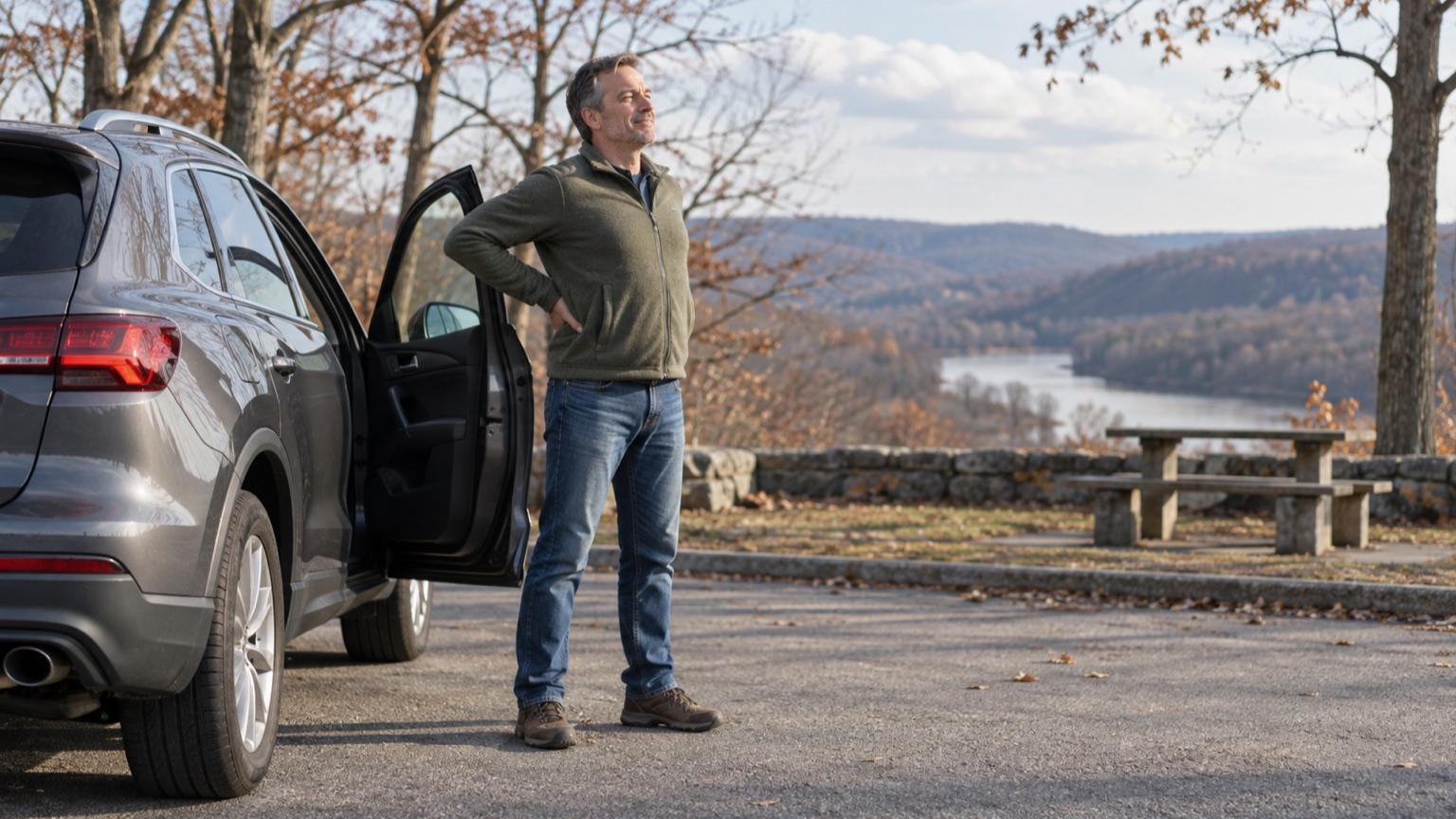
Three hours on I-95 after Thanksgiving dinner, and you're finally home. You step out of the car, leave the bags where they are, and wait a moment before your back will let you stand straight.
Sitting in one position for hours can leave your back sore, and on a long drive you can't get up and move until you find a place to stop. A few changes can make the trip easier on your back, starting with how you set up your seat and when you stop. We'll also cover how to handle the bags, what helps once you're home, and when soreness is worth getting checked.
Why hours behind the wheel are hard on your back
Sitting for long stretches or in an awkward position puts pressure on your back (opens in a new tab). On a long drive, you sit in one position for hours with your feet on the pedals and your hands on the wheel, and there's little room to shift. Your lower back is the most likely place to feel it, since it supports most of your body's weight.
Then you pull into the driveway, and your back goes from hours of sitting still to moving all at once. Back pain usually starts just after you sit in one position for a long time, move suddenly, or lift something heavy. Getting home can bring all three. Climbing out of the car stiff, twisting to reach into the back seat, and pulling bags out of the trunk can bring on the pain or make it worse.
The bags in particular call for extra care, because lifting something heavy causes a sudden increase in pressure on your back, which can irritate its joints, discs, muscles, and nerves. In most cases, however, sudden low back pain has a common cause: an injury to the muscles and ligaments that support the back, such as a strain or a muscle spasm.
Set the seat before you pull out
You can take some of that strain off before you leave the driveway, starting with the seat. While you're parked, adjust the seat so you can fully press the brake pedal with a slight bend in your knee (opens in a new tab). Set the backrest so you're upright or leaning back a little. If your car has adjustable low-back support, set it so it rests comfortably in the curve of your lower back. If it doesn't, a small pillow or a rolled towel can go there instead, and so can a water bottle wrapped in a towel. On top of that, if your car has heated seats, turning them on as heat can help ease pain and relax your muscles (opens in a new tab).
As you get comfortable, keep the airbag in mind. Keep at least 10 inches between your breastbone and the airbag cover in the steering wheel (opens in a new tab). Sit as far back as you can while still reaching the pedals comfortably. So if sliding forward feels better on your back, don't let it cut into those 10 inches. Set your mirrors last, from that same position.
Stop every hour to walk
A well-set seat helps, but it doesn't replace getting up and moving. On a long drive, stop and walk around every hour (opens in a new tab). Plan your stops at safe places to pull off, such as the service plazas along I-95, and build the extra time into the trip. Once you're parked, get out and walk around for a few minutes before you get back in. That short walk takes some of the pressure off your back before the next stretch of driving.
Unloading the trunk when you get home
Once you're home, the trunk can wait. Avoid heavy lifting just after a long ride. If someone with you can handle the heavy bags, let them, and don't rush to empty the trunk yourself.
When you do lift a suitcase, get alongside it, bend your knees, and use your legs to stand up with it, keeping it close to your body. Turn your feet and your whole body toward where you're going instead of twisting while holding the weight, and get help if the bag is too awkward to manage.
Packing can make the next unload easier, too. When you can, use several smaller bags instead of one large, heavy suitcase (opens in a new tab). Wheels help once a bag is on the ground, but you still have to lift the bag into and out of the car.
What helps a sore back once you're home
If your back is still sore once the car is unloaded, resist settling into another chair, and try a little easy walking first. Gentle movement can help a sore back more than bed rest (opens in a new tab), though how much depends on the cause. If you're not sure how much activity is safe for you, ask your provider.
Along with walking, heat or ice can help. Heat may ease pain and stiffness, while ice can help with pain and swelling. You'll find how to use each safely, including who needs to take extra care, in our post on heat or ice. Home care is for ordinary soreness, however. A few warning signs mean you should get help instead.
Signs your back pain needs more urgent care
Go straight to the emergency room (opens in a new tab) if back pain comes with new trouble urinating or controlling your bladder or bowels, numbness between your legs or in your inner thighs, or new leg weakness. Our post on where to go for sudden low back pain covers other signs to get checked, such as back pain with an unexplained fever or after a hard fall.
Because you've been sitting for hours, keep an eye on your legs, too. After a long trip, contact your doctor as soon as possible (opens in a new tab) if one leg swells or you have unexplained leg pain or tenderness.
Getting help when back pain lingers or keeps coming back
Even without those warning signs, call your healthcare provider if the pain is severe or hasn't improved after three days (opens in a new tab). Also, if soreness keeps returning on your I-95 or I-91 commute, you can contact us at (203) 562-8600 to set up an evaluation.
You can start with us in one of two ways. Our chiropractors treat low back pain and other muscle, joint, and nerve problems at all five offices: East Haven, Meriden, Milford, Wallingford (Tuesdays and Thursdays), and West Haven. No referral is needed. Same day appointments are available.
Physical therapy is the other option. Our physical therapists treat back pain at our Wallingford office and help you move and function again after an injury, surgery, or illness. Physical therapy here always requires a physician's referral, and our chiropractors can refer you in house. If you're not sure which one to start with, you can check out our post on choosing between a chiropractor and a physical therapist, look through our FAQ page, or give us a call.
Whichever you choose, tell your provider which part of the drive bothers your back: sitting through traffic, getting out of the seat, or lifting a bag from the trunk. A physical therapist can also offer coaching on lifting, bending, and sitting (opens in a new tab), so if another long drive is coming up, ask what to change for that trip.